
Before a customer ever reaches your website, Google often shows them a map pin, a phone number and this week's opening hours. Local SEO for Singapore shops is mostly about keeping those signals accurate, current and consistent, and much of that work sits within a shop owner's own reach.
The real question owners ask us is narrower than whether to do SEO yourself: which local SEO tasks can I manage, and when should I pay for specialist help? Getting that split wrong is expensive in both directions. Doing everything alone can quietly starve a shop of attention, while paying a retainer for upkeep you could have handled yourself burns cash every month.
This article is written from our team's working judgement, built around one clearly labelled hypothetical shop. Every hour figure is a planning assumption rather than a record from client projects, and we flag each assumption where it appears.
In this blog, we discuss local search work and which setup and monthly tasks suit DIY. We also cover when to hire a specialist and compare owner hours and agency costs across three routes.
Table of Contents
What Does Local SEO for Singapore Shops Involve?
It involves four groups of signals: your Google Business Profile, the local information on your website, your reviews, and consistency across all of them. A shop owner can learn every one of these, so the practical question is which parts deserve your hours and which deserve a fee.
These four groups are also how we organise local work when we audit a shop's presence.
1. Your Google Business Profile
Your profile supplies the pin, hours, categories, photos and offers that appear on Google Maps and in local results. It is recurring upkeep, not a set-and-forget form, and it needs a login you control.
2. Local information on your website
Titles, internal links, location and contact pages, and structured data tell Google which page represents the shop. This group absorbs most of the one-time setup effort.
3. Reviews and reputation
Replying to reviews shapes both a ranking signal and a customer's decision to visit. Some replies need personal knowledge that no outsider can supply.
4. Consistency and measurement
Your name, address and phone details must match across the profile, the website and the directories that matter locally. Tracking real enquiries tells you whether the work is paying off.
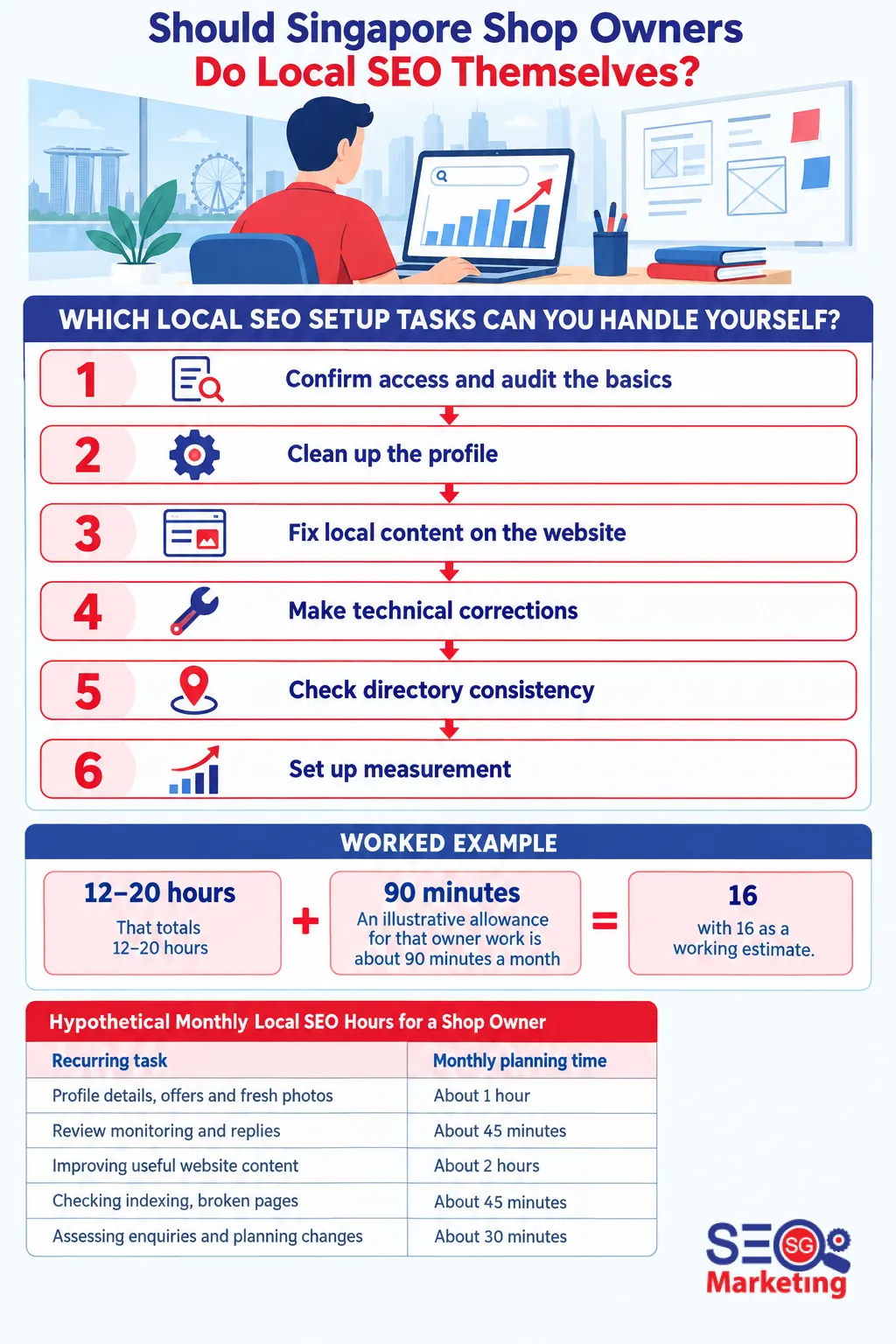
Which Local SEO Setup Tasks Can You Handle Yourself?
Most of them, provided you hold administrator access to your website and your Google Business Profile, and your site can be edited without a developer.
For a concrete example, picture a hypothetical Singapore shop. It has one location, an editable website with eight core pages, and no online checkout. Its 50 product pages share a template. The proposed task split and invented time estimates need practitioner confirmation. Every hour figure in this article is a planning assumption, not a record of client work.
A proposed one-time setup pass could run in this order:
- Confirm access and audit the basics (2–3 hours): logins for the website, domain, Search Console and the Business Profile.
- Clean up the profile (1–2 hours): categories, description, hours, services and photos.
- Fix local content on the website (4–6 hours): titles, internal links, and location or contact pages carrying your address accurately.
- Make technical corrections (3–5 hours): indexability, canonical tags and local business structured data.
- Check directory consistency (1–2 hours): matching name, address and phone details where they matter.
- Set up measurement (1–2 hours): an enquiry log or call tracking you will actually maintain.
That totals 12–20 hours, with 16 as a working estimate. It assumes the product pages share a template, so nobody is rewriting 50 product descriptions inside the budget. A rebuild, an inaccessible developer account, a profile reinstatement and verification waiting time all fall outside it.
Hypothetical Local SEO Setup Hours for a Shop
| Setup task | Planning hours (hypothetical) |
|---|---|
| Confirm access and audit basics | 2–3 hours |
| Google Business Profile cleanup | 1–2 hours |
| Titles, internal links, location and contact content | 4–6 hours |
| Technical corrections and structured data | 3–5 hours |
| Directory and business-detail consistency | 1–2 hours |
| Measurement setup | 1–2 hours |
| Total one-time setup | 12–20 hours, 16 as a working estimate |
How Many Hours a Month Does DIY Local SEO Take?
For the hypothetical shop, budget four to six hours monthly, with five as an unconfirmed working figure. The recurring loop is lighter than setup, but it never stops.
Our suggested priority is to check access, indexability and business details before adding content. This proposed order needs practitioner confirmation. For example, a profile post will not correct a wrong phone number or an excluded location page.
Reviews sit inside that loop. If you invite customers to post a review, keep it clean. Google Maps' policy forbids incentives for reviews and selectively soliciting positive reviews.
Here is how a hypothetical monthly round could split.
Hypothetical Monthly Local SEO Hours for a Shop Owner
| Recurring task | Monthly planning time |
|---|---|
| Profile details, offers and fresh photos | About 1 hour |
| Review monitoring and replies | About 45 minutes |
| Improving useful website content and internal links | About 2 hours |
| Checking indexing, broken pages and business-detail consistency | About 45 minutes |
| Assessing enquiries and planning changes | About 30 minutes |
| Total recurring work | 4–6 hours, 5 as a working figure |
When Is DIY Local SEO Enough for a Singapore Shop?
DIY may be enough for a shop with one location and an editable website. It also needs sound profile and indexing basics and someone who can maintain them consistently. The hypothetical five-hour allowance is not a validated minimum and needs practitioner confirmation. A second location calls for a setup review, not automatically a retainer.
Enough means the work produces the relevant enquiries and sales your shop actually needs. It does not mean ranking for a broad phrase such as 'Singapore gifts' — target the searches your customers really type.
If that routine is delivering, keep your money. A retainer is one option, not a requirement. The honest test is whether you can execute the work safely and consistently: update hours and products, request reviews within the rules, answer customers, and check the site brings relevant enquiries.
When Should You Hire a Local SEO Specialist?
For three situations: a bounded defect you cannot safely diagnose, a risk event, or a recurring backlog you cannot clear. Each justifies a different kind of engagement.
Google's own advice on hiring an SEO is blunt about one point: nobody can guarantee a number-one ranking. Treat any such promise as a reason to walk away.
1. A bounded technical problem
Take a hypothetical incident: a location page picks up a noindex directive during a website update, and Google stops showing it. Google has to crawl a page to detect the directive, and once you remove it, requesting indexing through Search Console still does not guarantee the page returns. Google's noindex documentation explains the crawl requirement, while its recrawling guidance says a request does not guarantee inclusion; we would not promise a turnaround either.
For this proposed example, a repair might take six hours, but the estimate needs practitioner confirmation. Confirm the affected URLs and access, then correct the template or SEO plugin setting. Check canonical tags, sitemap inclusion and internal links. Live-test the page, document the work and follow up. Request indexing only when the live page is indexable. Such a job suits a written fixed fee for the defined scope, with anything extra quoted separately. These are assumed commercial terms for an example, not a quotation.
2. A suspension or manual action
A suspended Business Profile, unexplained deindexing or a confirmed manual action is diagnostic work. Stop speculative DIY changes, get the cause identified, and only then decide what stays in-house.
3. A recurring backlog
If content, fixes and profile updates pile up month after month, recurring support earns its fee. But a one-off repair should not need a permanent contract just to stay repaired — once you know the cause, keeping it fixed is usually within your reach.
What Stays Your Job After You Outsource Local SEO?
The production and the diagnosis move to the agency; the truth of your business does not. The proposed split below needs practitioner confirmation, and responsibilities depend on the agreement. The owner may still handle:
- Accurate business information: offers that end, hours that change, stock priorities.
- Current photos of the shop and products.
- Replies that need personal knowledge, such as a refund question or a regular customer's complaint.
- Approval of changes before anything goes live.
An illustrative allowance for that owner work is about 90 minutes a month: 30 minutes of photos, 30 of review replies, 15 confirming offers, hours and contact details, and 15 approving proposed changes. That assumes roughly eight new reviews a month and one consolidated approval round. These are invented planning assumptions, not measured participation, and need practitioner confirmation. A verification check, a serious complaint or a move adds time.
Keep ownership of your accounts. A profile owner can grant a manager access without sharing a password, and Google's guidance is for owners to keep owner-level access when a third party works on the profile. Grant access only to people you trust, and never surrender your account as a condition of service.
If you are unsure what an SEO consultant actually does day to day, our guide on this site explains the role in plain English. If you already know you need help, the cost comparison below shows how the routes differ.
How Do DIY and Specialist Support Compare Over Six Months?
Compared across the same hypothetical shop's first six months, the three routes differ in owner hours and cash outlay, not in promised results, because no route can promise rankings. The owner-hour figures are invented planning assumptions, not time records, and need practitioner confirmation. The one-off total assumes the repair replaces setup work, but the scopes have not been reconciled. Do not rely on that total until the practitioner confirms it. Check exclusions and GST treatment against actual scopes and quotations.
Judge whichever route you choose against relevant enquiries and actual business outcomes. A single good month does not prove which change caused it, so beware of crediting the wrong thing.
All three routes exclude hosting, domains, paid software, advertising, a rebuild, checkout development and Goods and Services Tax (GST) where applicable, plus the monetary value of your own time. Agency hours are never added to owner hours, so the comparison covers workload and cash, not equivalent expertise.
On GST: as of 2026, the prevailing rate in Singapore is 9%, and under Inland Revenue Authority of Singapore (IRAS) rules only GST-registered businesses may charge it. Confirm a supplier's GST registration and whether a quote includes it before comparing prices.
If you want to go deeper, our guide on how to budget for SEO covers fee structures in detail, and you can compare our SEO pricing directly. When hiring a professional SEO agency is the step you are considering, we have a separate guide on what that decision involves.
DIY vs One-Off Fix vs Recurring Support Over Six Months
| Route (first six months) | Owner hours (hypothetical) | Agency fees | What it covers |
|---|---|---|---|
| DIY | 46 (16 setup + 5 per month) | None | You run setup and every recurring task yourself |
| One-off specialist fix | 40 (10 setup + 5 per month, assuming the repair replaces six setup hours) | A written fixed fee for the defined repair | The specialist fixes the defect; setup and recurring work stay with you |
| Recurring support | 11 (2 onboarding + about 1.5 per month) | A monthly fee, quoted in writing | The agency runs setup and monthly delivery; you supply information, photos and approvals |
Conclusion
Most of local search is learnable. A Singapore shop owner with one location and an editable site may be able to maintain the basics consistently. The hypothetical five-hour allowance is not a validated minimum and needs practitioner confirmation. A bounded technical defect, a suspension, a manual action or a recurring backlog may warrant specialist help. None automatically requires a permanent contract.
Every hour and dollar comparison in this article is a labelled hypothetical, so treat them as planning shapes rather than promises. We can turn those shapes into a concrete scope. We audit shops, clean up Google Business Profiles, diagnose indexing faults and manage recurring local work. We quote in Singapore dollars and use white-hat methods, without guaranteed rankings.
If you want a second opinion on what to keep in-house, talk to us before you sign anything.
Get an Honest Read on Your Shop's Local Search
Tell us what is working, what is stuck and how much time you actually have each month. We will say what to keep in-house and what is worth paying a specialist to fix.
Frequently Asked Questions
A single-location shop with an editable website and admin access may manage the basics alone with consistent effort. A suspension, unexplained indexing problem or recurring backlog may warrant specialist help.
For the hypothetical shop, the draft assumes 12–20 setup hours and 4–6 monthly hours. The working estimates are 16 and five hours respectively. These invented assumptions are not time records and need practitioner confirmation. A larger site, more products or a rebuild changes the budget.
For a bounded defect you cannot safely diagnose, a profile suspension or confirmed manual action, or a backlog that keeps recurring. Ask for a written fixed fee for defined repairs, and a retainer only when the workload justifies it.
Yes. Grant manager access rather than sharing your password, and keep owner-level access. Google's guidance says owners should retain owner access when a third party works on the profile.
Accurate business information, current photos, replies that need personal knowledge and approvals. The hypothetical plan assumes about 90 minutes monthly, but that invented estimate needs practitioner confirmation. Verification, a move or a serious complaint can add time.

SEO Marketing Singapore
Author
SEO Marketing Singapore is a Singapore web development and marketing agency offering SEO, web design and development, consulting, copywriting and domain and hosting for businesses.