Rankings are usually the last thing to move in a well-run local campaign. That is why the question of how long local SEO takes in Singapore deserves a better answer than a single number of months. Before anything reaches page one or the map pack, smaller signals shift first: impressions, profile actions, indexed pages and enquiries.
The generic advice that local SEO takes three to six months misses how Singapore actually searches. Proximity matters, so one city behaves like many local markets. Verification timing, competitor density and client-side approvals all reshape the calendar.
Without realistic expectations, good campaigns get judged on the wrong metric at month two. Some businesses abandon the work just as traction builds. Others spend on rankings when their real gap is profile eligibility, website usability or unanswered enquiries.
In this blog, we discuss what genuinely shapes a local SEO timeline in Singapore. We explain which starting conditions speed progress up or slow it down. You will see how Google Business Profile SEO fits in and what a Google Maps ranking timeline realistically involves. We then cover metrics that show movement before rankings arrive.
Table of Contents
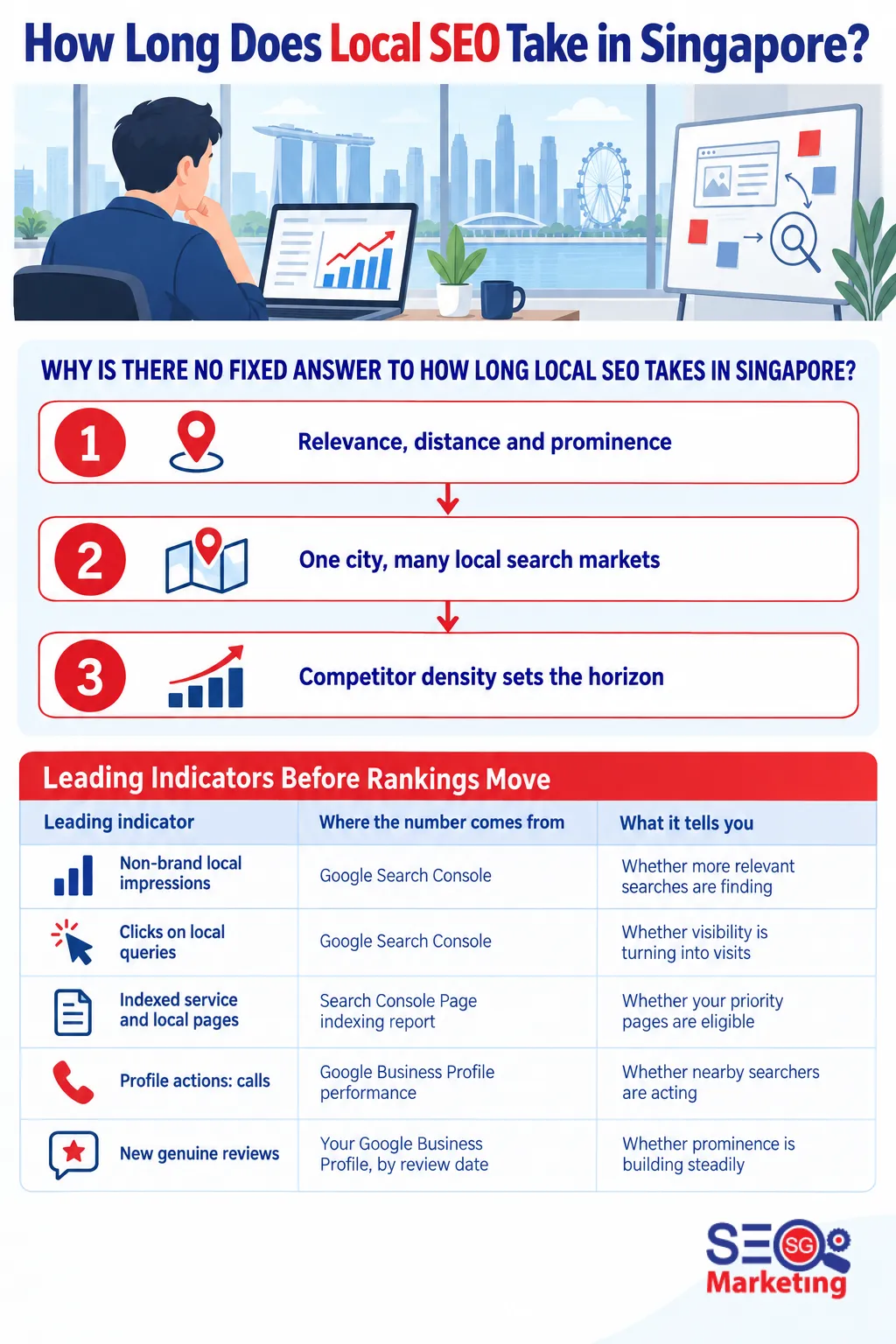
Why Is There No Fixed Answer to How Long Local SEO Takes in Singapore?
Because Google builds local results from factors no agency fully controls, every honest timeline is conditional. According to Google's local ranking guidance, local results are mainly based on relevance, distance and prominence. Complete, accurate profile information makes a business more likely to appear for relevant local searches, and reviews and links contribute to prominence.
In practice, when we run local campaigns for Singapore service businesses, we treat timing as a forecast with dependencies rather than a promise. Three local realities shape that forecast more than any generic rulebook. If you are new to the mechanics, our guide to local SEO in Singapore covers the fundamentals step by step.
1. Relevance, distance and prominence
Relevance matches your profile and content to what people search for. Distance weighs how far each business is from the customer who is searching. Prominence reflects how well known and well regarded your business is, online and offline. None of these can be bought, and Google offers no way to request a better local ranking.
2. One city, many local search markets
Singapore is one city, but local search in it is not one market. A business can enter the map pack near its own location while staying invisible to searchers across the island. Publishing a page for an area you do not genuinely serve does not create proximity there, so we measure across multiple fixed points rather than one search.
3. Competitor density sets the horizon
Renovation, moving, and aesthetic or medical clinic categories are dense in Singapore. Established competitors there hold advantages in review velocity, links, brand recognition and location relevance. Less crowded business-to-business niches usually show useful movement sooner, while dense categories demand a longer, steadier build.
What Should Count as Month Zero in Your Local SEO Forecast?
Month zero should be the kickoff date when usable access is in hand — website, Google Business Profile and Search Console — not the contract-signing date. We also recommend recording a second date: the day the first priority fixes actually go live. Access delays should not be misread as Google taking longer to respond.
Treat this as a recommended forecasting method rather than an industry standard. Define both dates in writing at kickoff so progress is judged fairly.
According to Google's SEO Starter Guide, changes can take anywhere from hours to several months to appear in search results. That range is exactly why a month-one plan should list milestones, not ranking dates.
Which Starting Conditions Change Your Local SEO Timeline in Singapore?
Your starting condition moves the calendar more than your industry label does. According to Google's local-ranking guidance, reviews and links can contribute to prominence. That is why starting conditions can change the forecast. A newly verified profile, a weak review base, a technically troubled website and a crowded category can each progress differently.
From running local campaigns for Singapore service businesses, our team's observation is that the patterns below hold across trades. They are general patterns drawn from professional judgement, not a promise of a particular timetable for any single business.
1. A newly verified profile
A brand-new profile starts with little accumulated trust. Profile discovery and activity signals usually move first, while broad map-pack coverage builds gradually as details, services and genuine reviews accumulate.
2. An established profile with weak reviews
The website often gains organic relevance before the map pack follows. Prominence grows as genuine reviews arrive, so the review programme is usually the critical path.
3. A technically troubled website
Indexation problems, duplicate content and weak location signals hold everything back. Allow a reasonable assessment window after fixes go live, because search engines need time to reprocess the site.
4. A dense, competitive category
Where established competitors already dominate, expect slow, incremental gains across content, reviews, citations and authority. The realistic horizon is considerably longer than in quiet niches.
5. A strong business with an under-optimised profile
This is usually the quickest scenario to show movement. Accurate categories, complete services and consistent details often unlock strength the business already has.
Starting Conditions That Shape a Local SEO Timeline
| Starting condition | What usually moves first | What it means for your timeline |
|---|---|---|
| Newly verified Google Business Profile | Profile discovery and activity signals | Trust builds gradually; do not judge by map-pack placement alone |
| Established profile, few reviews | Organic service pages often move before the pack | Prominence grows as genuine reviews accumulate |
| Technically troubled website | Little until indexation and duplication fixes go live | Allow time after fixes deploy before judging progress |
| Dense, competitive category | Slow, incremental gains across many fronts | Established competitors hold review, link and brand advantages |
| Strong business, under-optimised profile | Usually the quickest to show movement | Accurate categories and details unlock existing strength |
How Do You Improve Local Search Visibility in Singapore While You Wait?
You work the inputs Google actually reads: a complete and accurate Google Business Profile, genuine reviews, and pages that state clearly what you do and for which areas. Google Business Profile SEO in Singapore starts with eligibility, not tactics.
1. Confirm eligibility and complete your profile
According to Google, a business must be eligible for a Google Business Profile. Service-area businesses should accurately represent their real operating model, including how their address is shown. According to Google, verification methods are automatically determined, and available options depend on business type, public information, region and hours. Google says its review can take up to five business days after steps are completed. Where mail verification is available, Google says most codes arrive within 14 days. For Singapore entities, ACRA says its free Bizfile search can show basic business status and registered address. ACRA lists a Business Profile at S$5.50.
2. Ask for genuine reviews the right way
Google permits asking customers to share genuine experiences. It prohibits fake, incentivised or biased review activity of any kind. No specific review count is a ranking formula; steady, honest requests after each completed job are what build prominence over time.
3. Publish pages that carry service and location intent
Original service pages that describe your work honestly, with consistent business details across your site, help Google connect you to nearby searches. Thin area-page clones add little; genuinely useful content for the areas you actually serve adds far more.
What Does a Google Maps Ranking Timeline in Singapore Look Like?
In most campaigns, map-pack visibility lags behind organic movement. Relevance can be improved through content relatively quickly; prominence — the reputation side of the ranking — builds more slowly.
A typical pattern is appearing in the pack for searches near your verified location first, then for broader coverage as reviews, activity and consistency grow. In dense Singapore categories, that progression takes patience.
As a matter of agency policy, we do not promise position one, page one by a fixed date, or permanent map-pack placement. According to Google, there is no way to request or pay for a better local ranking. Providers offering fixed positions are selling something search engines do not sell.
Leading Indicators Before Rankings Move
| Leading indicator | Where the number comes from | What it tells you |
|---|---|---|
| Non-brand local impressions | Google Search Console | Whether more relevant searches are finding you |
| Clicks on local queries | Google Search Console | Whether visibility is turning into visits |
| Indexed service and local pages | Search Console Page indexing report | Whether your priority pages are eligible to rank |
| Profile actions: calls, direction requests, website clicks | Google Business Profile performance reporting | Whether nearby searchers are acting on your listing |
| New genuine reviews | Your Google Business Profile, by review date | Whether prominence is building steadily |
| Qualified enquiries | Forms, tracked calls and messaging, deduplicated | Whether visibility is becoming revenue |
Which Metrics Show Progress Before Rankings Arrive?
Track leading indicators, because rankings lag behind them. Rising relevant impressions, indexed priority pages, profile actions, fresh reviews and qualified enquiries all tell you whether a campaign is gaining traction before positions move.
We recommend measuring visibility across a consistent set of queries, devices and fixed locations rather than one personalised search from your office. Treat this as a recommended measurement approach; the exact configuration should suit your coverage area and category.
If qualified enquiries become your yardstick, define the word first: which channels count, what counts as qualified, and which business hours apply. Without definitions, month-to-month comparisons mislead.
For wider visibility tactics beyond local search, our tips from an SEO expert in Singapore cover search results more broadly.
What Can Push Your Local SEO Forecast Back?
Most delays come from client-side dependencies rather than the work itself. Access, factual inputs, approvals, verification cooperation, photographs, review requests and enquiry handling all sit with the business owner.
We state this as a general project-management consideration, not a complaint. The fix is administrative, not technical: agree every responsibility in writing before kickoff, with named owners and dates.
When a dependency slips, the honest response is to re-date the milestone and say why, rather than quietly absorbing the delay or blaming the search engine.
If you are planning budget alongside timeline, our guide to how much SEO services cost in Singapore breaks down typical fee ranges.
Client-Controlled Dependencies That Move a Forecast
| Dependency | Why it moves the forecast | How to keep it on track |
|---|---|---|
| Account access | Nothing can be audited or fixed without owner or manager access to the Business Profile | Grant access at kickoff, within days rather than weeks |
| Service and coverage details | Accurate categories, services and areas depend on your facts | Provide them in the first week |
| Copy and page approvals | Unpublished work cannot influence rankings | Set internal approval deadlines before kickoff |
| Verification cooperation | Google may request proof only you can supply | Respond to verification requests promptly |
| Photographs | Current, genuine images strengthen the profile | Schedule a simple photo session |
| Review requests | Only your team can ask real customers | Share a short, honest request after each job |
| Enquiry handling | Unanswered calls waste the visibility you earn | Track response times during business hours |
When Should You Re-Forecast — or Fix Something Else First?
Re-forecast whenever a material condition changes: access, approvals, verification outcomes, competitor activity or how enquiries are handled. A credible timeline is a living document, revised openly when its assumptions break.
One honest caveat: local SEO is not always the right first investment. If profile eligibility is unclear, the website cannot convert visitors, or telephone and form enquiries go unanswered, those gaps usually deserve attention first. That is conditional guidance — your circumstances, not a universal rule, decide.
If you are unsure which situation you are in, ask us through our contact page and we will tell you plainly.
Conclusion
There is no universal answer to how long local SEO takes in Singapore. An honest forecast begins with your starting condition and category density. It must also account for Google's relevance, distance and prominence factors, plus dependencies you control. Commit to milestones rather than positions. Judge early progress through impressions, profile actions, reviews and qualified enquiries.
At SEO Marketing Singapore, we help sole proprietors and established companies become easier to find on Google through white-hat SEO. Our work includes web design and development, copywriting, and domain and hosting packages. We quote in Singapore dollars and work with clients in Singapore and overseas. We stay in touch after launch as search engines change.
If you want a realistic, milestone-based local SEO plan, our team can review your starting condition. We can tell you which indicators to measure first.
Plan a Realistic Local SEO Timeline
Share your category, location and goals, and we will map the milestones and leading indicators worth tracking — with honest timelines and no ranking promises.
Frequently Asked Questions
There is no fixed timeline. Movement usually appears first in leading indicators such as impressions, profile actions and enquiries, with page-one and map-pack visibility for core service-plus-area terms following over months of consistent work. Dense categories such as renovation and moving take considerably longer than quiet niches. Any provider quoting one number for every business is guessing.
No. Google states that there is no way to request or pay for a better local ranking, and local results depend on relevance, distance and prominence. A responsible agency commits to milestones — audits, fixes, pages, reviews — not positions.
It varies. Google determines the verification method, and availability depends on factors such as business type, public information, region and hours. Exceptions, re-verification or suspensions can stretch the wait, so build a buffer into your forecast rather than assuming a single date.
Non-brand local impressions and clicks in Google Search Console, indexed service pages, Google Business Profile actions such as calls and direction requests, new genuine reviews, and qualified enquiries. Rankings lag behind these, so they are the fairest early evidence of traction.
Yes, as long as the requests are for genuine experiences without incentives or bias. Google prohibits fake, incentivised or manipulated review activity. A steady, honest request after each completed job is the sustainable approach — and no specific review count is a ranking formula.

SEO Marketing Singapore
Author
SEO Marketing Singapore is a Singapore web development and marketing agency offering SEO, web design and development, consulting, copywriting and domain and hosting for businesses.