Plumbers, movers, tutors and consultants across Singapore win customers every week without a single walk-in visit. A Google Business Profile for a Singapore service-area business can appear in local search and on Google Maps. No customer needs to come to your door, because Google decides eligibility on in-person service, not premises.
The confusion starts with paperwork. Three addresses often get treated as customer-facing locations when they are not:
- An address registered with the Accounting and Corporate Regulatory Authority (ACRA)
- A leased mailbox in the central business district
- A Housing and Development Board (HDB) flat used for admin
None of them is automatically a customer-facing location. Treating one as if it were is usually where profiles fail verification.
Getting this right matters beyond compliance. Publishing a home address invites unwanted visits and clashes with housing conditions. Extra listings built to cover more districts create policy risk that is far harder to repair than to avoid.
In this blog, we discuss Google Business Profile eligibility without a shopfront and when to show or hide an address. It also covers home-based and virtual-office rules, listing limits, and keeping your profile, website and schema consistent.
Table of Contents
How Does a Service Area Business Appear on Google Maps in Singapore?
Yes, it can — the shopfront is not the requirement; in-person service is. Google's Business Profile eligibility guidance asks whether a business makes in-person contact with customers during its stated hours. It expressly allows businesses that travel to the customer instead of receiving them. A repair firm, mover or tutor working at clients' homes can therefore qualify.
An online-only business, by contrast, is not eligible, because there is no in-person contact at all. Google does list limited stated exceptions, so an unusual model should be checked against the current policy before you invest in setup. Eligibility also remains subject to Google's review and verification processes, so no one can honestly promise profile approval or visibility.
One sensible pre-setup step is confirming your entity on ACRA's Bizfile portal using your trading name or Unique Entity Number (UEN). In our view, this is a reasonable compliance check, not an ACRA or Google rule stated in these words. A clean record confirms identity, but eligibility still turns on the real operating model. A business-to-business (B2B) consultant, technician or contractor whose own staff physically attend client premises can be assessed as a service-area business; a remote-only adviser cannot rely on that model.
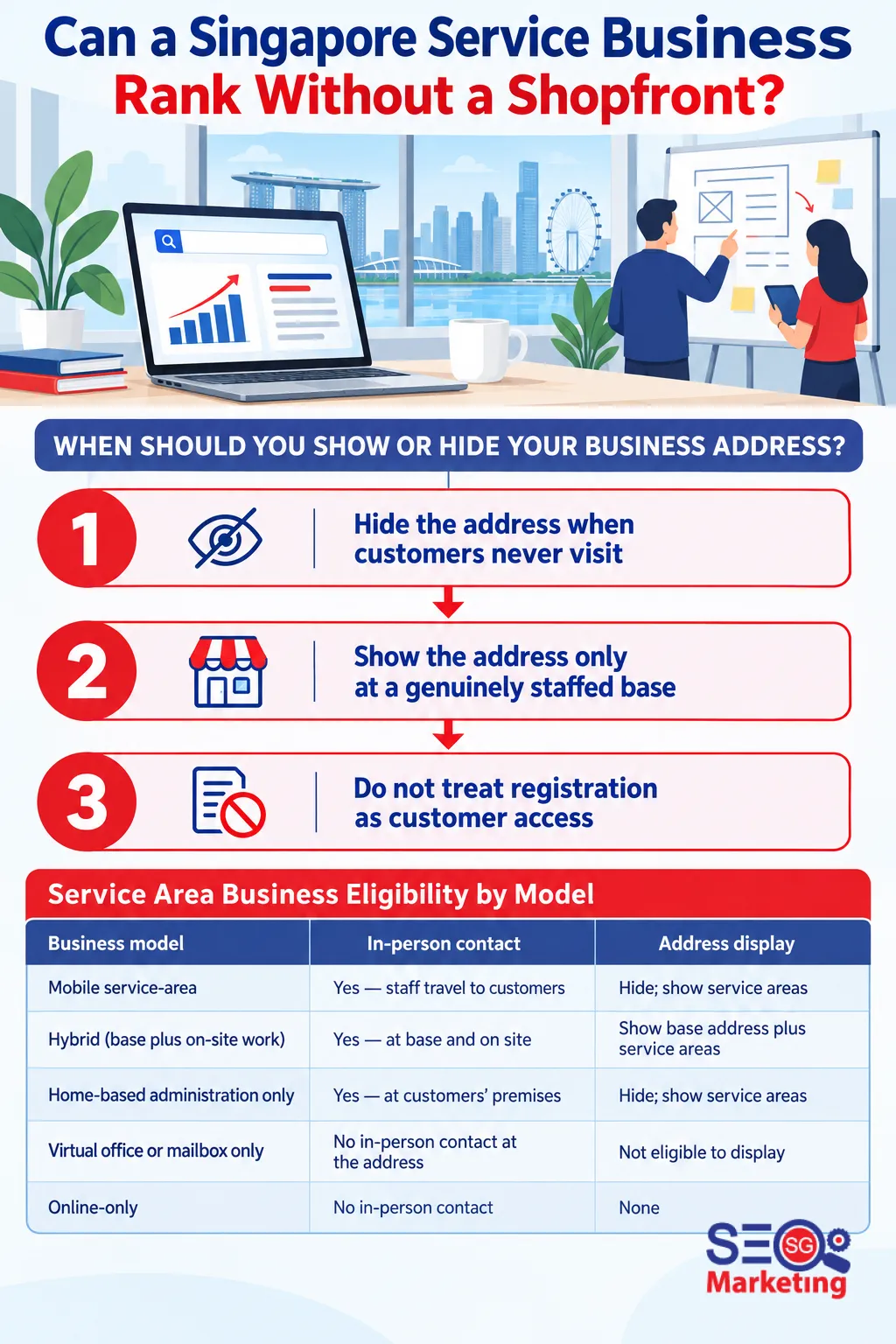
When Should You Show or Hide Your Business Address?
Hide the address when customers never visit; show it only when your own staff receive customers at a staffed base.
It depends entirely on where customers are actually received. If nobody visits your base, Google's guidance for service-area businesses says the address must be hidden from the public and replaced with a truthful service area. If customers genuinely attend a location with permanent on-site business signage that your team staffs during stated hours, you may show it.
1. Hide the address when customers never visit
Google requires service-area businesses to keep their address out of public view and describe the areas they serve instead. Hiding it is compliance, not a weakness. The profile still needs a real base address entered privately for setup or verification, without publishing it. Google allows up to 20 service areas. Their overall boundary should not extend more than about 2 hours’ driving time from the base.
2. Show the address only at a genuinely staffed base
A hybrid business may display a storefront address and add a service area, but only where its own team staffs the location and can receive customers during the published hours. Occasional, appointment-only use of an otherwise unstaffed office does not qualify.
3. Do not treat registration as customer access
An address on ACRA paperwork or a lease is not evidence that customers may visit. Test each location against Google's staffing and access expectations, not against what the documents say. We help clients assess the actual customer-access arrangement before profile work begins.
Service Area Business Eligibility by Model
| Business model | In-person contact | Address display | Profile eligibility |
|---|---|---|---|
| Mobile service-area (cleaners, movers, repair) | Yes — staff travel to customers | Hide; show service areas | Eligible, subject to verification |
| Hybrid (base plus on-site work) | Yes — at base and on site | Show base address plus service areas | Eligible only with permanent on-site signage and staff during stated hours |
| Home-based administration only | Yes — at customers' premises | Hide; show service areas | Eligible, subject to HDB or URA conditions |
| Virtual office or mailbox only | No in-person contact at the address | Not eligible to display | Not an eligible location |
| Online-only | No in-person contact | None | Not eligible, limited exceptions |
| Client-site B2B (consultants, contractors) | Yes — staff attend client premises | Hide; show service areas | Eligible as service-area, subject to verification |
Can a Home-Based Business Use Google Maps in Singapore?
Yes, a home-based business can appear, but the housing rules shape how. Under the Home Office Scheme, the Urban Redevelopment Authority (URA) and HDB approve residential premises for administrative use only, and clients or customers are not allowed to visit. Always check the applicable approvals, tenancy terms, management committee (MCST) rules, licence conditions and current HDB or URA requirements for your specific premises and activity.
1. Separate administration from customer access
The scheme lets you run the paperwork of the business from home. It does not convert the flat into a shopfront, so the profile must be configured as service-area with the address hidden.
2. Verify with the real address, publish none of it
Enter the genuine flat address for Google's verification process, then keep it out of public display. That protects both policy compliance and the household's privacy.
3. Keep the residence off the website too
A hidden profile paired with a contact page that prints the flat number undoes the point. The section on contact pages below covers what to publish instead.
Does a Virtual Office Qualify as a Google Business Profile Location?
Usually not. Google treats a rented physical mailing address where the business does not actually operate as ineligible. Paying rent, receiving mail and quoting a prestigious postal code do not create a customer-facing location.
Co-working spaces are assessed on facts, not labels. Google expects clear signage, the ability to receive customers during business hours, and staffing by the business's own team. Some serviced offices meet that test; many do not, so we do not treat them all alike — the actual staffing, signage, customer-access and operational facts decide.
One question settles most cases: if a customer turned up unannounced during business hours, would your own staff receive them at a signed, recognisable location? If the honest answer is no, the address is not eligible, whatever the lease says.
Show or Hide the Address: A Decision Guide
| Your situation | Address setting | Why |
|---|---|---|
| Customers attend during stated hours at a permanently signed location, staffed by your team | Show | Google permits storefront display for genuinely staffed, permanently signed bases |
| Staff travel out; nobody visits the base | Hide | Service-area rules require hiding the address |
| Pre-arranged meetings only, otherwise unstaffed | Hide | Occasional visits do not make a base a storefront |
| Mail, parcels or registration only | Not eligible | The address is not an operating, customer-facing location |
How Many Listings Can One Singapore Business Have?
One. Google's guidance is that a service-area business has a single profile for its central office or base. Additional profiles are allowed only where the business has separate, legitimate locations, each with its own staff and its own service area. A home base plus two virtual offices is not three locations.
Fabricating locations with relatives' homes, storage units or borrowed desks is policy risk. We deliberately avoid claiming that any particular number of listings triggers suspension. The risk lies in duplication itself. Verification cannot be demonstrated at premises the business does not truly operate.
Where a profile does come down, remove ineligible listings and keep the one genuine profile. Assemble evidence of the real business and base, then submit a reinstatement request rather than churning out replacements.
Does Hiding Your Address Hurt Your Local Rankings?
Not in the way owners fear, and hiding it is required anyway where customers are not received at the base. Google's help guidance says local results are mainly based on relevance, distance and prominence. Complete, accurate business information helps with relevance. It does not promise ranking for any listed service area.
So treat service areas as a truthful description of where you work. They may help you appear for searches in those areas. They do not create a footprint that guarantees visibility in every named district. Nobody should promise rankings after a profile change. What you can control is accuracy:
- categories
- hours
- photos
- reviews
- the website behind the profile — the same foundations as our organic SEO strategies
For wider reading, our guide sharing tips from an SEO expert in Singapore covers how local and organic results interact. If budget is part of that conversation, our affordable SEO packages in Singapore are a practical next read.
What Should Your Contact Page and Schema Say When the Address Is Hidden?
Our recommendation — and this is a privacy-conscious implementation choice, not a rule Google states — is that a hidden address should stay hidden everywhere. Do not print it on the contact page, and do not tuck it into JSON-LD markup while keeping it visually off the page. Consistency between profile, page and schema does not require publishing a private address; it requires the identity, phone, website and service model to agree.
An example contact-page wording, which each business should verify against its own real arrangements, is: [Business Name] provides on-site services across [actual areas]. We do not operate a customer walk-in location. Call [number], WhatsApp [link], email [address] or use [form]. Company UEN: [UEN].
On the markup side, we generally prefer an Organization schema carrying name, URL, logo, telephone, sameAs, contactPoint and areaServed, with no address property. We would not invent a postal address just to satisfy a LocalBusiness rich-result requirement — confirm the final markup and check that it discloses nothing private.
Profile, Contact Page and Schema Consistency
| Item | Google Business Profile | Contact page | Schema markup |
|---|---|---|---|
| Business name | Legal or trading name | Same name | name property |
| Phone | Direct or controlled number | Same number | telephone property |
| Address | Private address kept private | None shown; coverage stated | No address property |
| Service coverage | Truthful service areas | Same areas described | areaServed property |
| Hours | Staffed response hours | Same hours | contactPoint.hoursAvailable, if applicable |
Common Service-Area Misconceptions in Singapore
| What owners believe | What the rules say |
|---|---|
| A paid CBD virtual office must be accepted | Rent and mail handling do not create an eligible, customer-facing location |
| Showing my home address improves rankings | If customers are not received there, the rules require hiding it; rankings turn on relevance, distance and prominence |
| One listing per district boosts coverage | One service-area business has one profile; extras need real, separately staffed locations |
| An occasional client meeting makes my office a storefront | A genuinely staffed base with stated customer hours is required to display an address |
How Do You Track Enquiries from a Service-Area Profile?
Once eligibility and setup are settled, measure the enquiries the profile brings rather than the settings themselves. These are optional practices worth considering, not a fixed specification we present as an established implementation:
- Tag the profile's website link with UTM parameters so profile traffic is identifiable in analytics
- Use call tracking and form tracking with a source field in your customer relationship management (CRM) tool
- Record WhatsApp click events, and report qualified leads with duplicates removed
- Define what a qualified lead means for your business before reading any dashboard
Two caveats apply. A WhatsApp-link click is an intent signal, not proof that a message was sent or that a lead qualified. If calls are recorded, tell callers the purpose and handle personal data appropriately. Under the PDPA, stop retaining recordings once their collection purpose is no longer served and retention is no longer necessary for legal or business purposes. Have the actual recording system reviewed for your circumstances rather than adopting a fixed retention period blindly.
Conclusion
You do not need a shopfront to be found; you need in-person service, a truthful profile and a consistent website. A service-area business in Singapore may appear in local search and on Google Maps with a hidden non-customer-facing address. It should list real service areas, respect home-office and premises rules, and avoid duplicate listings. None of this guarantees rankings, but it keeps the profile verifiable and the business findable.
That is the work we do at SEO Marketing Singapore: assessing business models against Google's current guidance, configuring profiles correctly, and building the site and content behind them. If you are comparing options, our affordable SEO packages in Singapore and our SEO packages and monthly rates set out what each tier covers.
If you want a second opinion on whether your model qualifies, get in touch through our contact page. If you want a website and profile configured to match it, we will take a look.
Set Up Your Profile the Right Way
Tell us how your business actually serves customers, and we will help you configure your profile, website and tracking the compliant way.
Frequently Asked Questions
You can enter it privately for verification, but because Home Office Scheme rules do not allow clients or customers to visit, the address must be hidden and the profile set up as service-area. Never publish the flat number publicly.
No. A rented mailing address where the business does not operate is not an eligible location, and it does not create local prominence. Only a genuinely staffed, signed location that receives customers during stated hours can be displayed.
Only the areas your team genuinely serves. Service areas describe real coverage; they may help you appear in those areas but do not guarantee ranking in each one.
Not by itself. A Bizfile record confirms your entity name and UEN, but eligibility turns on in-person customer contact and your real operating model under Google's current rules.
Online-only businesses are not eligible for a Google Business Profile, subject to Google's limited stated exceptions. Visibility then comes from organic search, content and other channels instead — check the current policy before applying.

SEO Marketing Singapore
Author
SEO Marketing Singapore is a Singapore web development and marketing agency offering SEO, web design and development, consulting, copywriting and domain and hosting for businesses.