
Most Singapore online stores sit on hundreds of product pages carrying the same supplier blurb as every other retailer selling that item. That makes one question urgent: which product descriptions should you rewrite first, and what should each new page actually say?
Rewriting an entire catalogue in one push is rarely affordable, and rewriting by sales volume alone wastes money. Some pages are not indexed, some point Google to a different URL, and some sell well at margins too thin to justify deep work. A queue built from sales, gross margin, search exposure, stock status and the effort needed to verify facts spends your writing budget where it can earn something back.
Copied supplier copy is not an automatic penalty risk, so this is not about dodging trouble. It is about giving shoppers a page worth reading, and giving Google a reason to show yours rather than a near-identical alternative.
In this blog, we discuss the signals behind a rewrite queue and an illustrative prioritisation worksheet. We also cover a before-and-after example, facts retailers must verify, and how to judge whether the work paid off.
Table of Contents
What Signals Decide Which Product Pages to Rewrite First?
A rewrite queue is built from six signals: sales, gross margin, search exposure, stock status, verification status and estimated effort. We present this as a planning method to adapt to your own catalogue and writing capacity — not a fixed formula, and not something every store should copy unchanged. The queue also sits inside wider ecommerce SEO best practices, which we cover elsewhere on this blog.
Before commissioning any copy, three checks come first: is the URL indexable, which URL does Google treat as canonical, and should product variants share a single page? Rewriting a URL that points Google elsewhere is wasted work, and variant structure changes the scope of every rewrite.
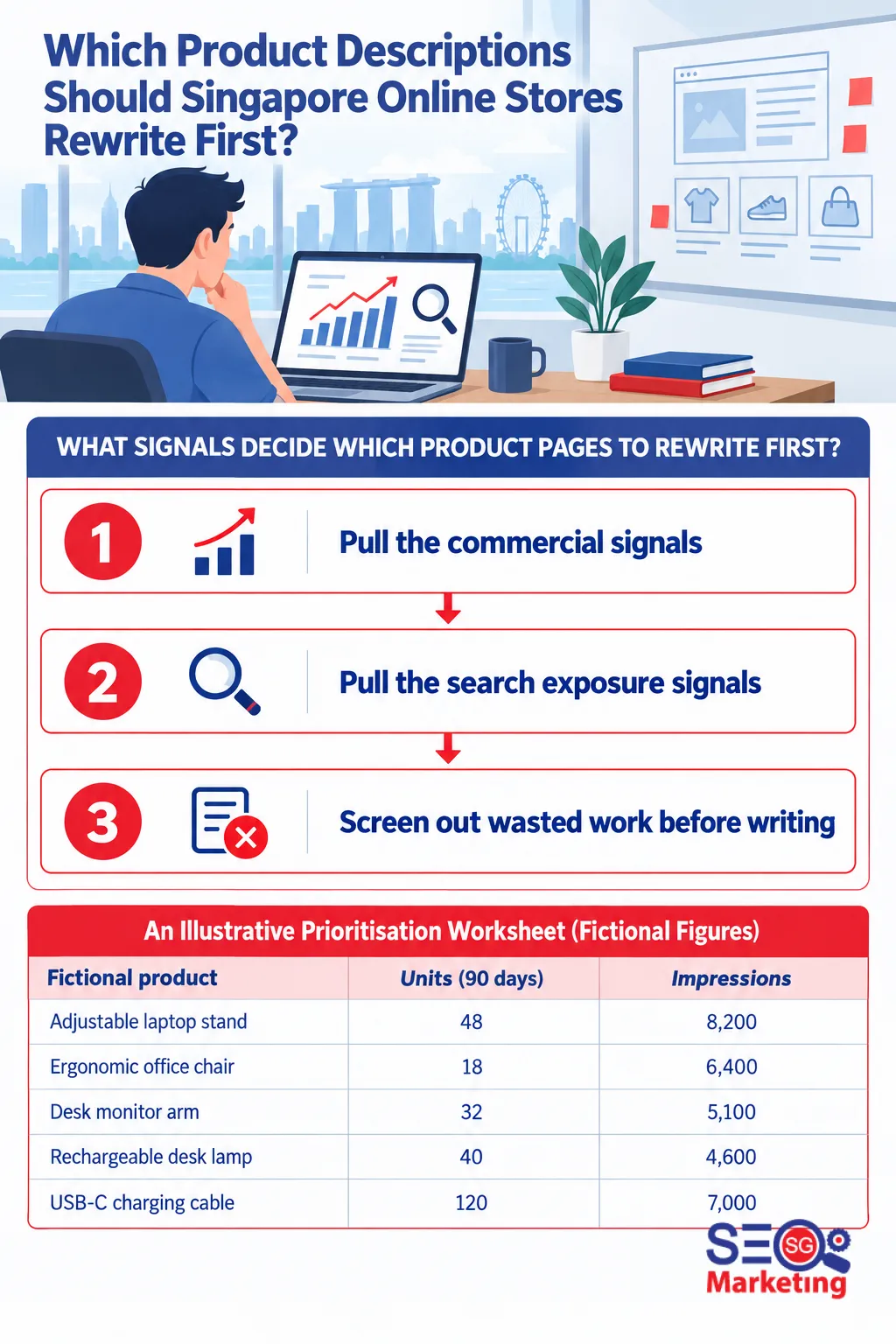
1. Pull the commercial signals
Count fulfilled units sold over a recent, complete window — for example, the last 90 complete days — excluding cancellations and returns. Multiply that figure by a gross margin you define in SGD per unit. This is a planning screen, not total profit: it excludes fulfilment and advertising costs, which you should review separately, and it is not an accounting method. Confirm your own cost breakdown and tax treatment before relying on it. The screen exists because revenue alone flatters expensive, low-profit products.
2. Pull the search exposure signals
Take Web impressions for the exact product URL from Google Search Console over the same window, all countries, and review the Singapore-filtered figures alongside them. Impressions measure exposure — whether the page appeared in results — not total market demand for the product. A page with few impressions may face weak demand, poor discovery or an indexing problem.
3. Screen out wasted work before writing
Check robots directives, noindex tags, canonical selection and variant structure first. Google's documentation explains that it selects a canonical URL when several pages look alike — and a canonical preference you set is not a guarantee of which page Google actually chooses. Sort these issues out before a writer spends an hour on a page that search engines will not treat as the one to show.
How Do You Build a Rewrite Prioritisation Worksheet?
A worksheet makes the judgement visible and arguable: every row shows the numbers behind its tier. The example below is illustrative — every product, figure, stock condition and tier is fictional, created to show the shape of the method. Nothing in it is client data, and none of it is a measured result.
The columns are defined as follows:
- Units: fulfilled units sold over the last 90 complete days, excluding cancellations and returns
- Impressions: Google Search Console Web impressions for the exact URL over the same window
- Gross margin: SGD selling price excluding GST, less product cost, per unit — excluding fulfilment and advertising costs, which are reviewed separately
- Effort: rough combined staff time for verification, drafting and upload
- Tier: a judgement from all the above plus the information gap and stock position — not a scoring formula
Define the margin with whoever keeps your accounts. This is a planning measure to compare products against each other, not a profit calculation.
An Illustrative Prioritisation Worksheet (Fictional Figures)
| Fictional product | Units (90 days) | Impressions | Gross margin (S$/unit) | Effort | Resulting tier |
|---|---|---|---|---|---|
| Adjustable laptop stand | 48 | 8,200 | 24 | Moderate | Full rewrite — demand, margin and a missing fit guide |
| Ergonomic office chair | 18 | 6,400 | 110 | High | Full rewrite — sizing and assembly questions |
| Desk monitor arm | 32 | 5,100 | 38 | Moderate | Full rewrite — compatibility evidence available |
| Rechargeable desk lamp | 40 | 4,600 | 22 | Moderate | Full rewrite — thin copy, verified runtime data |
| USB-C charging cable | 120 | 7,000 | 3 | Low | Light enrichment — best-seller, small margin per sale |
| Insulated bottle | 65 | 3,900 | 12 | Low | Light enrichment — add capacity and care details |
| Storage basket | 30 | 1,800 | 9 | Low | Light enrichment — add usable dimensions |
| Desk organiser | 8 | 180 | 6 | Low | Wait — weak demand and effort |
| Laptop docking station | 15 | 11,000 | 42 | High | Hold — device support unverified |
| Travel adaptor | 25 | 4,200 | 14 | Moderate | Hold — out of stock, restock unconfirmed |
| Discontinued lamp model | 6 | 2,300 | 18 | Low | Exclude — no further supply |
| Unlaunched shelf unit | 0 | 0 | 45 | Moderate | Hold — no confirmed launch or stock date |
What Can a Fictional Worksheet Teach About Conflicting Signals?
The interesting rows are the ones where signals clash. Suppose a best-selling charging cable moves many units at a tiny margin. An ergonomic chair sells fewer units at a far higher margin. The cable may deserve a quick compatibility or delivery fix before a full rewrite. Its small margin makes the expected return and cost of deeper work important to assess. The chair may justify a full rewrite covering sizing and assembly questions.
A docking station with strong impressions may need to wait because the supplier cannot substantiate which devices it supports. That page goes on hold: fix the evidence before publishing a confident mistake. A shelf that has not launched yet shows zero impressions, which tells you nothing reliable about its future demand.
What Happens to Products You Exclude From the Queue?
Excluding a product from the writing queue is a separate decision from what happens to its URL. A temporary stockout does not by itself require removing the page — Google's guidance for retailers acknowledges that products go temporarily unavailable, and the right treatment depends on your circumstances. A permanently discontinued line may stay as a useful support page, redirect to a genuinely equivalent replacement, or return an appropriate unavailable status.
Choose based on the situation, not a blanket rule. If your catalogue has never been audited, start with our guide to which SEO tools small businesses use for website audits — the numbers feeding this worksheet come from the same places.
What Each Rewrite Tier Means
| Tier | When it applies | Typical work |
|---|---|---|
| Full rewrite | Available product, worthwhile margin, relevant search exposure and a real information gap | New copy built on verified fit, dimensions, contents and delivery details |
| Light enrichment | Basic description works but lacks dimensions, compatibility or buying guidance | Add the missing verified facts and adjust headings; keep the structure |
| Hold | Facts unverified, stock unconfirmed or launch date unknown | Resolve the evidence or stock question first; write afterwards |
| Wait | Weak demand and thin margin relative to the effort required | Leave until sales, season or margins change |
| Exclude | Permanantly discontinued with no further supply | No writing; decide the URL's fate separately |
How Do You Improve Product Descriptions for SEO?
Improve a product description by adding verified buying information the supplier blurb omits. Include fit, dimensions, load limits, contents and fulfilment details rather than extra adjectives or repeated keywords. Our team suggests the approach below as a way to do this. All specifications and delivery details in the example are fictional.
For GST-registered retailers, IRAS generally requires publicly displayed prices to include GST, subject to exceptions.
1. Verify the facts before writing
Our team recommends asking the retailer to confirm, in writing, the facts a shopper needs to make a decision:
- Model number and variant
- External, usable and packed dimensions; weight and load limits
- Materials, finishes and capacity
- Power requirements and plug type, where relevant
- Compatibility and exclusions, with model-level evidence rather than a wholesaler's 'universal'
- Included parts; installation and care instructions
- Warranty duration, who honours it and what it covers — distinct from the manufacturer's own terms
- Returns information, current availability and dispatch lead time
- Delivery or assembly charges, stated separately from dispatch time
Mark every fact as retailer-confirmed, supported by a current document, or unresolved. An unresolved buying-critical fact should block publication; do not write around it.
2. Add buying information, not adjectives
A fictional supplier version reads: 'Premium aluminium laptop stand. Ergonomic design, durable and portable. Suitable for home and office.' A fictional rewrite might read: 'Adjustable aluminium laptop stand for laptops with 11 to 15.6 inch screens. Check whether the device fits the support tray. The tray measures 260 × 220 mm and carries up to 5 kg. Height adjusts from 80 to 160 mm, and silicone pads protect the contact points. Stand only — laptop and accessories are not included. Check the underside of your laptop against the support ledge, which measures 240 × 20 mm, before ordering. For Singapore orders, allow two to three working days after dispatch. Checkout shows delivery charges.'
Add a short FAQ answering 'Will my laptop fit?' Use tray and ledge measurements rather than another screen-size claim. Link to the delivery policy and relevant products the shopper may need. Put the critical measurements beside a labelled photograph, not only in the copy. Do not add medical benefits, compatibility guarantees or certification badges without evidence.
Rewrites of this kind sit inside our wider SEO services in Singapore, alongside audits, technical fixes and ongoing content support.
3. Keep prices clear and compliant
Where exclusive and inclusive prices are both shown, the GST-inclusive price must be at least as prominent. Apply the rule to product pages and checkout alike, and check IRAS's stated exceptions for your situation. The rule governs public price displays, not the internal margin worksheet described above.
Is Copied Supplier Copy a Google Penalty Risk?
No. Google's Search Central documentation says duplicate content is generally not a violation of its spam policies, and ordinary supplier descriptions do not trigger an automatic penalty. But sameness has a cost. If your page offers the same information as everyone else's, Google may have little reason to show yours. It may also have little reason to index every near-identical URL. A snippet that matches other sites proves sameness, not a penalty, and snippets can change with the query.
Before blaming the descriptions, inspect the pages themselves:
- Robots directives and noindex tags
- Canonical selection and variant structure
- Whether the page renders fully for a crawler
- Internal links and sitemap inclusion
- Stock history and availability over time
Thin copy is only one possible contributor to low exposure. Rewrite to answer buying questions competitors leave unanswered, not to hit an invented uniqueness percentage. A rewrite does not by itself guarantee indexing or rankings.
A Fictional Before-and-After: Laptop Stand Copy
| Element | Typical supplier text | What a rewrite adds |
|---|---|---|
| Fit | 'Suitable for home and office' | Screen-size range plus tray measurements a shopper can check |
| Load and dimensions | Nothing stated | Tray size, maximum load and height adjustment range |
| Contents | 'Portable' | What is and is not included in the box |
| Delivery | Nothing stated | Delivery estimate after dispatch and where delivery charges appear |
How Do You Measure Whether Rewrites Paid Off?
You measure rewrites by comparing like with like: a set of rewritten pages against a suitably matched, untouched group over defined before-and-after windows. A whole-site traffic trend cannot isolate the effect of the copy, because everything else moves at the same time.
1. Compare like with like
Choose untouched pages with similar demand, margins and search exposure, and watch impressions, clicks and orders per URL across the same window. The untouched group is your baseline, not a promise of what the rewritten pages would have done.
2. Log everything that changed
Record stock, prices, promotions and seasonal shifts alongside the comparison. This is an observational study of your own store — it can suggest the work paid off, but it cannot by itself prove causation. Honest measurement beats a flattering number.
3. Review the queue on a schedule
Re-tier whenever stock, seasonality, customer questions, margins or verification status change. Fast-moving catalogues justify a monthly pass; slower ones can run quarterly. The cadence is a planning choice — set it to how quickly your catalogue turns, and assign someone to own the review.
Rewrites work best as one lever among several. Pair them with our guide on how small businesses can do SEO on a limited budget, and with our longer read on key strategies for organic SEO mastery.
Conclusion
Deciding which pages to rewrite first is a commercial question before it is a writing question. Pull sales, gross margin, search exposure, stock status and verification effort into one queue. Give full rewrites to available, commercially worthwhile pages with a real information gap. Enrich adequate pages lightly. Hold or defer the rest until the facts, stock or demand justify the spend. Verify every buying-critical fact before it goes live, and measure the work against a matched group rather than a whole-site trend.
We help Singapore online stores with exactly this work: auditing which pages search engines can actually show, building the prioritisation queue, and writing product copy that answers the questions supplier blurbs ignore. Once the signals are in one place, the question of which product descriptions to rewrite first answers itself.
If you would like a hand building your queue or rewriting your first batch of pages, the SEO Marketing Singapore team is happy to look at your catalogue with you.
Plan Your Rewrite Queue With Our Team
Send us your catalogue and we will audit the pages, propose the tiers and write product copy that answers your shoppers' real questions.
Frequently Asked Questions
No. Google's documentation says duplicate content is generally not a violation of its spam policies. The risk is sameness: identical pages give Google little reason to show yours, and a rewrite does not guarantee indexing or rankings.
Not automatically. A temporary stockout does not by itself require removing a page. Decide the fate of discontinued URLs separately — keep a useful support page, redirect to a genuine equivalent, or return an appropriate unavailable status.
Model number and variant, dimensions, materials, load limits, compatibility, included parts, warranty terms, dispatch lead time and delivery charges. Mark each fact retailer-confirmed, document-supported or unresolved; unresolved buying-critical facts should block publication.
Usually not. Build a queue from sales, gross margin, search exposure, stock and effort, and start with available products that have a real information gap. Adequate pages can take light enrichment; weak opportunities can wait.
For GST-registered retailers, IRAS guidance on displaying prices generally requires publicly displayed prices to include GST. Where both figures are shown, the GST-inclusive price must be at least as prominent.

SEO Marketing Singapore
Author
SEO Marketing Singapore is a Singapore web development and marketing agency offering SEO, web design and development, consulting, copywriting and domain and hosting for businesses.